Showing posts with label Tech. Show all posts


And then, I started counting how many of these cool new features and products are available now, or in the immediate future. This year's Google I/O conference was one of the company's best in terms of presentation (it was never boring) and the sheer volume of news we've seen. Assistant, Home, Daydream... by the time Google showed off its chat apps Allo and Duo, I started writing bullet points down as I was sure I wouldn't be able to remember all that. 
The answer is — you guessed it — very close to zero. 
Google Home will be available in the fall. The gadget is based on a new, smarter-than-ever AI called Google Assistant, which is also not available yet, and Google hasn't even announced a clear timeline for its launch.
The company's VR platform, Daydream is also coming in the fall. The widely rumored new VR headset from Google turned out to be a reference design for other manufacturers and not an actual product. All we saw at this stage was a pencil drawing of a generic-looking headset and remote. 
 And there goes the dream of a buffed up Google Cardboard.
I know this is a long, sad list, but bear with me. Chat apps Allo and Duo will be available on iOS and Android later this summer. Android Instant Apps, a nifty feature which lets you use Android apps without installing them on your phone, is coming later this year. Some people expected new Nexus phones, but that didn't happen (yet). Android Wear 2.0 is coming in the fall.
Very few of the products are even at the conference as early demos. Home, Allo and Duo, Instant Apps — not even attendees of Google I/O can get their hands on them (the Android Wear and Android Auto updates being the exceptions).
So is there anything that Google showed on Wednesday that's actually available to users now? Only one thing by my count: The Android N beta. And that's just a beta, not a full product; Google (or Mashable, for that matter) does not recommend anyone should install it unless you're a developer or one of the most advanced and curious of users. While Android N is likely coming sometime during the summer, it doesn't even have a name yet. 


There are two caveats to this. First, this was only the first day of the conference; it's still possible for Google to launch something (or many things) cool that we'll actually be able to buy or use soon. 
And yes, Google I/O is primarily a developer conference; by design, it's looking forward. Its format is similar every year: Google drops a lot of info about the next version of Android, which is typically still in development, announces a ton of software and possibly shows off one or two hardware gadgets. Project development schedules don't always line up with events, and it's better to announce a product for later than to launch a half-baked one now. 
But Google I/O is also Google's biggest event of the year; the time when the company announces its most important new products. One would expect at least some of this stuff to be available now or soon. At least last year, we got the new Google Photos and wide access to Inbox right away.

I've seen some chatter on social media about this, with a few unhappy users calling the products "vaporware." Since this is Google we're talking about, that's a vastly unfair assessment; the company will certianly follow through on the products announced (though that hand-drawn VR headset does look mighty suspicious). 

Knowing only one language can really change the way you see the world, and it's usually not for the better.

While some take the easy approach and just assume that everyone speaks English, others feel a little embarrassed about not being able to understand people from around the world in their mother tongues. After all, there are few things more beautiful than language, the form and function of which reveal so much about the people who speak it.
For those in the latter group who want to experience culture as authentically as possible, this device is about to shift your perspective on global travel.

Meet the Pilot. It's a tiny, in-ear device that translates English, Spanish, French, and Italian in real time.


Developers from Waverly Labs hope to bridge cultural gaps by providing people with a program that's easy to use while still being culturally respectful. They want to help us live life without borders.

Andrew Ochoa ideated the program when he met a French woman and immediately felt communicative distance between them.


The Pilot instantly translates conversations so that people who speak two different languages can talk without the clumsiness that typically comes along with such encounters.

All you have to do is give Pilot earbuds to both people involved and start chatting!


Best of all, the device and associated app work offline, so you won't rack up roaming charges while using it abroad. Many compare the program to the Babel Fish from "The Hitchhiker's Guide to the Galaxy."
According to the story, "If you stick [a Babel Fish] in your ear, you can instantly understand anything said to you in any form of language." The birth of this technology brings science-fiction to life.

It will only translate four languages upon release, but more will be added in the future with a focus on East Asian, African, Arabic, and Slavic languages. To learn more about the project, check this out!


The Pilot program will be released next fall, and each unit will retail for $129. If you'd like to preorder your own device so you can hit the ground running on your next European adventure, you can do so here.
Buon viaggio a tutti!

Our obsession with selfies — we take millions of them a day — is finally generating something useful: innovation.
World, meet the automated selfie stick. It extends, or telescopes, on its own, has a pair of beauty lights that extend from the back of the iPhone holder and even fans that fold out to blow your hair back for that perfect, wind-swept look.
It’s the craziest and most impractical selfie stick ever. It’s also, sadly, not available for purchase.
Created by Thinkmodo — the madcap hacker/video-makers/marketers that brought you Devil Baby and Super Strong Meter Maid Lifting Taxi — the automated selfie stick is a working gadget, but there are only two (one is a backup) and they were built to promote the upcoming season of Lifetime’sUnreal.

Apple just made a massive bet on both China and the ride-hailing industry with a $1 billion investment in Didi Chuxing, the Chinese ride-hail company recently valued at $25 billion. BuzzFeed News confirmed the investment with Apple.
The move is a major play in China for Apple, where the company has recently struggled and faced heightened regulations on its services. It also gives it an instant stake in ride-hail, and to some extent pits it against its neighbor, Uber.
“We are making the investment for a number of strategic reasons, including a chance to learn more about certain segments of the China market,” Apple CEO Tim Cook told Reuters.
Didi, which is also backed by Tencent and Alibaba, says it has nearly 300 million users in 400 Chinese cities. In a statement, CEO Cheng Wei called the investment, the largest it has ever received, an “enormous encouragement and inspiration for our four-year-old company.” Other Chinese and international investors also participated in the funding round, per the press release.
Uber, the leading US ride-hail service, is seven years old, valued at over $60 billion, and, according to CEO Travis Kalanick, has been spending over $1 billion every year in an attempt to win the China market.
This isn’t Apple’s only automotive play. In addition to this step onto Uber’s turf, Apple is reportedly hard at work on an electric car, an effort it calls “Project Titan.” It also has CarPlay, an in-car system that’s already in the market.
The investment comes as the company reported a decline in both iPhone sales and revenue last month, the first time the company’s revenue has declined since 2003.


The online payday loan industry was dealt a serious blow Wednesday when Google banned it from its advertising networks. But short-term, high-interest lenders still have somewhere to go, for the time being at least: Microsoft’s Bing, which powers much of Yahoo’s search operation and is a distant number 2 in the search market.
Bing has not announced a ban on the lenders, who Google described as peddlers of “harmful financial products.” Instead, Microsoft told BuzzFeed news that it “respects the integrity of consumer choice” and is “listening to consumer and industry feedback with respect to payday lending ads.”
Oh, and “our advertising policies comprise strict requirements for advertiser compliance, and expressly prohibit any misleading or illegal practices,” a Microsoft spokesperson said in an emailed statement.
While Google is the king of search ads, the consumer and civil rights groups working to ban online payday loan advertising also went to Microsoft, according to Aaron Rieke, a principal at the Washington, D.C. tech and policy consulting firm Upturn,which did some of the research those groups relied on.
Microsoft “heard us out, read the report, we’ve had good conversation, at this point they haven’t gotten back to us and changed their policies,” Rieke said.
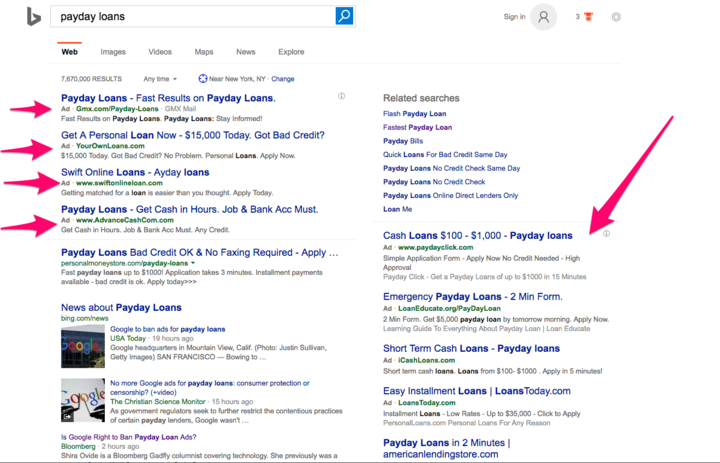
Microsoft declined to comment when asked about its interactions with the advocacy groups. A quick search on Bing for phrases like “payday loans” shows plenty of paid results from advertisers.

Via bing.com
“Unlike Google, Bing didn’t have as many policies in place concerning payday lending,” Rieke said.
A Microsoft spokesperson pointed to its own policies, which say that advertisers “must ensure they comply with all applicable local laws and regulatory requirements” and that advertisements for payday loans, along with other types of consumer financial products, “can raise appreciable compliance concerns and may attract heightened scrutiny.”
According to data from comScore, Google has 64% of the desktop search market, while Microsoft has just over 21% and Yahoo has 12%.
Before Google’s payday lending advertising ban — which will take effect in July — it had instituted policies specific to the industry, such as only allowing ads to show up when people searched for loans specifically, and requiring lenders to disclose rates and terms in the ads.
Short-term, high interest loans often end up with effective interest rates well over 100%, and are frequently paid off with new loans — a system that can trap borrowers in a cycle of debt. Online payday lenders also frequently charge high fees to borrowers and, a CFPB study found, can cause customers to lose access to the traditional banking system entirely.


Cuban sculptor Alexis Leiva Machado, better known as Kcho, has helped Google open a small “technology center” in Havana that offers free internet via Chromebooks, complete with those goofy cardboard VR headsets. And it’s a State Department dream.
The opening is a small but vitally important victory for both Google and the US State Department, both of whom would love to see US tech firms provide internet services on the island nation.
Brett Perlmutter, head of Google’s Cuban operations, has been courting the country along with other Google execs since at least June of 2014. Notably that was months before President Obama’s surprise announcement (a surprise to the American public, at least) in December of 2014 that the US would begin to normalize relations with the country.

As the Associated Press notes, the connection at the new Google “technology center” is provided by Cuba’s national telecom company. It wasn’t clear who financed the new high-speed fiber connection, though Kcho told the AP he paid for it himself without providing specifics.
Curiously, the new Google technology center also dons the logos of companies like Microsoft, Facebook, Instagram, and Apple’s Safari browser.

Previously the US ran covert tech operations in Cuba, introducing “Cuban Twitter” from 2009 until 2012 with the aim of stirring a revolution. The messaging service, known as ZunZuneo (Cuban slang for a hummingbird’s tweet), was secretly financed by the US Agency of International Development and only became public after an investigation by the Associated Press.
But the State Department and Silicon Valley no longer need to force their way into the relatively isolated communist country. They’ve been let in the front door, thanks to the slow but significant normalization of relations with Cuba.
Google is still standing in the foyer, but they’ll no doubt be invited into Cuba’s dining room, basement, and bedroom in short order.


Microsoft has announced that it will continue to offer its Gold Xbox Live service for free in China.

However the news has disappointed some console owners who believe a subscription would enable them to access more content.

China's Xbox Gold service is very limited compared with other markets in order to comply with the country's strict censorship laws.

The free trial was supposed to have ended this week.

China is the only country in which access to a regionally locked-down version of the online Gold service is free.

Regular membership in most countries includes online multiplayer functions, free online games and discounts on others.

Online games still require government approval before they can launch in China, which means that many are unavailable.

Sharing the news on its official Weibo account, a popular Chinese micro-blogging platform, Microsoft said it would continue to be free "for reasons you understand".

"To say that Chinese Xbox fans were not amused might be an understatement," reports the Tech in Asia website.

"Fans are incensed at what many see as a pattern of constant delays."
The Xbox One gaming console went on sale in China in 2014, after a 14-year ban on consoles was lifted.

Microsoft has been contacted by the BBC for comment.


The FBI and the US National Highway Traffic Safety Administration have added their voices to growing concerns about the risk of cars being hacked. 

In an advisory note it warns the public to be aware of "cybersecurity threats" related to connected vehicles. 

Last year Fiat Chrysler recalled 1.4 million US vehicles after security researchers remotely controlled a Jeep. People who suspect their car has been hacked were told to get in contact with the FBI. 

The public service announcement laid out the issues and dangers of car hacking. 

"Modern motor vehicles often include new connected vehicle technologies that aim to provide benefits such as added safety features, improved fuel economy and greater overall convenience," it read. "


With this increased connectivity, it is important that consumers and manufacturers maintain awareness of potential cybersecurity threats." 

 It went on to offer tips to both drivers and manufacturers including: 
  • Ensuring vehicle software is up-to-date Keeping an eye out for recalls 
  • Being careful when making modifications to vehicle software 
  • Exercising discretion when connecting third-party devices to vehicles
  • Being aware of who has physical access to vehicles
The FBI also warned that criminals may latch on to online vehicle software updates by sending out fake messages that trick users into " opening attachments containing malicious software".

Both General Motors and BMW have recently issued security updates to mitigate the risk of remote attacks that would have allowed hackers to open doors and, in the case of GM, start the engine. 

Fiat Chrysler was forced to recall millions of vehicles after Wired magazine demonstrated how hackers could remotely take control of car functions, including steering and brakes. However, there has not yet been a real-world example of such hacking.


If you've been reading the headlines about Apple's fight with the FBI, you know it's easy to assume we're all doomed.

Either law enforcement will lose the ability to thwart terrorist plots, or we'll be forced to live in a police state. Neither of those outcomes is exactly what you'd call appealing.

But Apple and the US government say those are exactly the things at stake in a court battle playing out in California. The two sides will meet before a magistrate judge on Tuesday in Riverside to make their arguments on whether Apple should build a new version of its mobile software so the FBI can hack into an iPhone 5C used by one of the San Bernardino shooters.

Apple argues it shouldn't be forced to make its phones less secure. The company, which has the backing of Silicon Valley notables like Google and Facebook, argues that creating software to break into one phone puts all other iPhone users at risk if the technology falls into the wrong hands. The FBI calls its request "modest," says it can't get into the device without Apple's help, and notes that information on the iPhone 5C could reveal more about the terrorists' activities.

Tuesday will be the first chance for both parties to make arguments before Magistrate Judge Sheri Pym. This could drag on for a while, even years. Judge Pym won't make a ruling immediately, and her decision faces appeal, possibly all the way to the Supreme Court.

"Because technology is moving at warp speed, we don't have two to three years to wait for a solution here in this particular case or in the boatload of cases after it," said Ed McAndrew, a former federal cybercrimes prosecutor and now a lawyer at Ballard Spahr.

While we wait it out, let's look at those worst-case scenarios from each side.
Going dark

In the eyes of the FBI, this is about keeping Americans safe. If law enforcement can't get access to data on iPhones, criminals can "go dark," the government says. FBI Director James Comey warned a Congressional committee earlier this month that offering a place no authorities could touch would create a haven for terrorists and criminals.

"Before these devices came around, there was no closet, basement or drawer in America that could not be entered with a judge's order," he said. Privacy is important, Comey said, but so is stopping murder, violence and pedophilia.
A loss in this case could also hurt the FBI's ability to get info from other tech companies, like Facebook.

Apple counters the government's warning by saying the FBI shouldn't be fixated on what it can access but realize there's a "mountain" of information that now is available because of technology.

"Going dark -- this is a crock," Apple CEO Tim Cook said during an interview with Time. "No one's going dark."

And experts say law enforcement has to find a way to fight crime in a world with strong encryption.

"The cost of maintaining a free society is that sometimes criminals won't be caught," said John Hasnas, a professor of ethics at Georgetown's McDonough School of Business. "Sometimes there are bad things we can't prevent."

Police state

Apple says the government is asking for a back door into all iPhones. If the FBI is able to get access to one phone, it'll ask for access to more, the company said.
There's also no way to guarantee that the loophole won't fall into the hands of criminals. It would become a top prize for hackers, and Apple undoubtedly would face attacks.

Apple also fears the government's demands won't stop with unlocking iPhones. Next, law enforcement could ask for access to an iPhone's camera and microphone to keep tabs on you, Eddy Cue, Apple's head of Internet software and services, said during a recent Univision interview.

"Where does this stop?" Cue said. "In a divorce case? In an immigration case? In a tax case with the IRS? Someday, someone will be able to turn on a phone's microphone. This should not happen in this country."

Then there are the international implications. No foreign government has a back door into Apple's products, but if the US government is successful, you can bet other countries, such as China, will come knocking too.

At stake are the "very freedoms and liberty our government is meant to protect," Cook said.

The FBI counters by saying that Apple helped it gain access to devices in the past without causing a loss of privacy and freedoms. Stacey Perino, an FBI electronics engineer, argued in a declaration that even if Apple didn't destroy the new software and criminals got access to it, they couldn't use it to hack all iPhones. That's because the code would run only on an iPhone if it had Apple's unique digital signature, Perino said.

Apple disagrees.

Finding middle ground?

Even the American public is split on the issue. According to a poll by CNET sister publication CBS News and The New York Times, half of Americans believe Apple should unlock the phone, while 45 percent think it shouldn't. More than two-thirds of Americans think unlocking the phone will make it at least somewhat likely that other iPhones are more vulnerable to hackers, and 58 percent of Americans remain concerned about losing some privacy in the fight against terrorism.

Some are hoping to find common ground.

Apple has recommended that a commission set the parameters for tech's interactions with the government. Two US lawmakers, Rep. Michael McCaul, a Republican from Texas, and Sen. Mark Warner, a Democrat from Virginia, agree and say they want Congress to form a commission charged with addressing issues on digital security that have put authorities and private companies at odds.
"Both the FBI and Apple are taking absolutist positions and in many ways are talking past each other," Warner said in an interview on Wednesday. "I do believe there are technology solutions that can protect encryption and not lead to back doors."

Warner hopes to have a commission approved within a couple of months and to see the group issue a full report in about a year.

Even if the US comes to some agreement, it won't matter much if other countries have conflicting policies.

In the end, all it could take is one more attack for everything to change.
"We know there will be another catastrophic attack on the homeland," said a former counterterrorism official at the White House who didn't want to be named. "When that happens, the privacy-security pendulum will swing wildly back toward the national security side. The public will forget about encryption and will be very willing to give up some of their privacy for enhanced security."

Mark Zuckerberg has been running around the world (literally) but his latest jog in Beijing has caused an uproar.

The Facebook CEO ran through Tiananmen Square earlier this week and posted a photo of it from China on Friday morning.
Some people criticized him for associating himself with a symbol of communism. Others said they were surprised he ran without a face mask given Beijing's pollution problems.
A few mused at the irony of the post itself: Facebook is banned in China, yet here he is, the leader of the company, posting from China.
Those who judged the run most harshly said this was Zuckerberg's way of "sucking up" to the Chinese government -- the people who can let Facebook operate in China and unleash the company's biggest untapped customer base.
"Are you praising communist leaders for allowing you to post your FB update at Tienanmen Square where 26 years ago they crushed young students with tanks?" Tran Vi wrote in the comments section.
"The pollution in Beijing is so bad today that most people won't even go outside without face mask on, and this guy takes a jog past Mao Zedong like he doesn't have a care in the world,"Sam Overholt wrote.
A Facebook spokesperson did not immediately respond to requests for comment. Zuckerberg has responded to a few comments on his photo, but none that criticize his run.
Zuckerberg has visited and posted from Beijing before. But on his last trip, he visited Tsinghua University, where he gave his first speech delivered entirely in Mandarin Chinese.
He also went for a run then, but in the historic city of Xi'an, home of the Terracotta Army.
Zuckerberg set a personal goal of running a mile every day this year. He often posts photos of his jog from his trips abroad, like the ones from Berlin and Barcelona a few weeks ago.
Facebook (FBTech30)faces a tricky political climate in China as it tries to open up for business in the country.
Earlier this year, Facebook made a change to its Android app to let customers in China connect to the social network.
In the fall of last year, Zuckerberg also met with President Xi Jinping while the Chinese leader was in Seattle.


On this week's edition of Tech Tent we look at two visions of the future of gaming, and we ask whether we should be worried or excited by the latest advances in artificial intelligence.

Sony stakes its VR claim

Finally, after all the hype and excitement, consumers are about to get their hands on virtual reality headsets - and we will find out whether there really is a market for this technology. Oculus Rift and the HTC Vive are both released in the next few weeks, and at the Games Developer Conference in San Francisco Sony unveiled its launch date and price.

While Playstation owners will have to wait until October to get their hands on the Sony VR headset, they will pay far less for it than for a Vive or Oculus setup. With nearly 40 million PS4 owners around the world, there's a ready-made market for Sony's offering, so by Christmas it's a fair bet that it will be the leader in VR.


Mind you, while there is now a huge amount of experimentation around VR and 360 degree video (see last week's BBC Click for example) there is still confusion about how it will be used beyond gaming. At a launch event for Nokia's Ozo 360 camera last night, I was shown a number of demos filmed with the device.
I stood next to the vocalist as a band performed, watched as a bear approached a group of nervous people at a campsite, and saw trainee astronauts learning about weightlessness in a swimming pool. The VR headset meant I could choose my own perspective on each scene, but once the novelty wore off the question remained - what is this for? Still, music producers, moviemakers and educationalists are all now producing 360 and VR material, so hopefully they will find an answer to my question.

AI - friend or foe?

At the end of a week where Google's AI program AlphaGo defeated a champion Go player, the artificial intelligence community is discussing what this triumph of machine over man means. I visited Microsoft's UK research lab in Cambridge where a number of artificial intelligence projects are under way , including one experiment using AI in the game Minecraft and another where a program examines scans of brain tumours.

The man who runs the lab, Chris Bishop, says it's wrong to paint a dystopian future in which machines gradually replace us as they get ever smarter. Instead he sees AI as a collaboration between humans and computers - for instance doctors using the brain tumour scanning program to assist their diagnoses rather than replacing them.
"We need to talk instead about a partnership in which machine intelligence and human intelligence work together," he says. "It's the case today, and will be the case for some time to come that the capabilities of machines, the capabilities of humans are different and complementary and if they work together they will be stronger than either of them alone."
Incidentally, for a different view, have a look at this piece from Tom Chatfield in the Guardian. He argues that in designing AI systems, we humans are making too many concessions to inflexible computers.

Watching as they play

Back to gaming and we look at the boom in a phenomenon which is familiar to anyone under 25 but a mystery to the older generation - watching video games online. The big player in the live streaming of video games is Twitch, which was bought by Amazon 18 months ago. But we hear from a rival, Ian Sharpe, who says his Azubu streaming service has a different approach. While Twitch lets anyone become a broadcaster, playing anything from Call of Duty to Minecraft, Azubu is more focused on professional eSports.
Last week it signed a deal with the Electronic Sports League to stream exclusive content from esports tournaments - and Ian Sharpe tells us that this is going to be a new boom area for media firms looking to reach those elusive "millennials" who don't watch boring old telly.
Tune in to Tech Tent on the BBC World Service at 15:00 GMT for all that and more or catch the podcast later.

Cyberattacks on taxpayer accounts affected more people than previously reported, the Internal Revenue Service said Friday.

The IRS statement, originally reported by Dow Jones, revealed tax data for about 700,000 households might have been stolen: Specifically, a government review found potential access to about 390,000 more accounts than previously disclosed.
In August, the IRS said that the number of potential victims stood at more than 334,000 — more than twice the initial estimate of more than 100,000.


"If somebody has all this information … we may see [a] resurgence next year of fraudulent tax returns," Paul Stephens, director of policy and advocacy for the Privacy Rights Clearinghouse, told CNBC in 2015.

The IRS discovered an incident involving its "Get Transcript" application last May, and the Treasury Inspector General for Tax Administration conducted a nine-month investigation. That review turned up the additional accounts that could potentially have been accessed.

Additionally, the IRS said there were 295,000 taxpayer transcripts that were targeted, but "access was not successful."

The agency said it will send mailings to affected taxpayers beginning February 29.
"The IRS is committed to protecting taxpayers on multiple fronts against tax-related identity theft, and these mailings are part of that effort," IRS Commissioner John Koskinen said in a statement. "We appreciate the work of the Treasury Inspector General for Tax Administration to identify these additional taxpayers whose accounts may have been accessed. We are moving quickly to help these taxpayers."


 Zuckerberg Furious With Employees For Erasing 'Black Lives Matter' Slogans

Facebook CEO Mark Zuckerberg furiously reprimanded employees in a private memo on Thursday, warning them to "stop crossing out 'black lives matter' and writing 'all lives matter'" on the company's famous signature wall in Menlo Park, California, calling such behavior "disrespectful" and "malicious."

"Black lives matter doesn't mean other lives don't," Zuckerberg wrote in the scathing message, posted on an internal forum and obtained by Gizmodo. "This has been a deeply hurtful and tiresome experience for the black community and really the entire Facebook community, and we are now investigating the current incidents," he added.

Employees have always been encouraged to write or draw on the whiteboard walls at Facebook -- essentially a real-life version of Facebook's virtual timeline wall. "We've never had rules around what people can write on our walls," wrote a seething Zuckerberg, "We expect everybody to treat each other with respect."

The Black Lives Matter movement started when George Zimmerman was acquitted in the murder of Trayvon Martin, and has since become a nationwide protest about police brutality against African Americans.

Facebook has drawn criticism in the past for its WASPy, frat-house culture, and suffers from a lack of diversity -- only two percent of employees are black.


Samsung Pay, Samsung's mobile payment service, is going to become a lot more useful to U.S users in the new year.

A report from Reuters says Samsung will expand Samsung Pay with online payment support, putting it in direct competition with the likes of PayPal and Visa Checkout.

Letting users pay for online purchases using Samsung Pay would also give Samsung's service an edge over Apple Pay, which lets users pay for things within apps, but not directly online.

Thomas Ko, Samsung Pay's global co-general manager, told Reuters, "wider handset availability of Samsung Pay as well as online payment support is coming soon."

At the moment, Samsung Pay is only supported by a few of Samsung's flagship smartphones, such as the Galaxy S6 and Galaxy Note 5. If Samsung ever hopes to see Samsung Pay take off and become widely adopted, it needs to bring the feature to not only its high-end smartphones, but also its low-end and mid-range lineups.

Since its launch in on Sept. 28 in the U.S., an average of eight transactions per user were made within the first month, according to Samsung.

Samsung Pay differs from Apple Pay and Android Pay in that it works with existing mobile payment and credit card terminals. Whereas Apple Pay requires businesses to install new NFC-enabled terminals, Samsung Pay-compatible smartphones are automatically detected as if they are credit cards when they're held near a magnetic terminal.


The festive season is upon us, and there's no better time of the year to surround yourself with your friends and loved ones for a nice meal or party. And with New Year's Eve coming up, we all have the chance to celebrate another year gone, and the exciting potential that comes with 2016's beginning.

While hosting any sort of get together is a lot of fun, it can come with a lot of work before and during. Luckily, smart home technology and connected gadgets can provide a digital helping hand when it comes to pretty much any type of in-home entertainment.

Here are just a select few ways smart gadgets can help you throw the best party on your street this holiday season — all made possible with the Samsung SmartThings hub and the compatibility that the open SmartThings platform has with hundreds of smart devices.


1. Control your music
A party simply isn't a party without some great music. Control the music all through your house or flat with a smart speaker system like the Samsung Wireless Audio-360. You can even program the system to turn music on at the opening of a door, which is a great and unexpected way to welcome a guest into your home or into a specific room.

2. Customise the lighting throughout your home
Smart lighting systems like Philips Hue let you control lighting in any room of your home. You can set your lights to coincide with your doorbell ringing or someone standing outside your front door. For example, you could set the lights to flash red when a guest is knocking, so you won't have to worry about not hearing them over the music and conversation.

3. Help guests wake up with an automatically brewed pot of coffee


Of course, a successful party starts with the quality of the people attending, but food and drink often come in at a pretty close second. After everyone has filled up on festive appetizers and cocktails, use a Samsung SmartThings Power Outlet in conjunction with your coffee maker to automatically brew a pot of coffee to keep everyone awake so you can keep the party going all night.

4. Keep guests out of rooms you’d like to keep private
You may not want attendees going into your bedroom or other rooms in your home. A Samsung SmartThings Motion Sensor can send you notifications when movement is detected in certain areas. You can also use it to turn lights on automatically when movement is detected. This way, you and your guest will be able to see without fumbling around for a light switch when heading to the kitchen for a drink of water in the middle of the night, or while heading downstairs to the basement for a fresh bottle of wine while the party is in full swing.


To become a true Jedi you have to construct your own lightsaber... and that's exactly what 23-year-old YouTuber Drake Anthony (a.k.a. styropyro) did.

Inspired by Allen Pan's flamethrower lightsaber, Anthony decided to put his own spin on the Jedi weapon using a 7-watt blue laser in place of fire. The result is a lightsaber that's powerful enough to cut through objects and light them on fire.

In the video, Anthony uses his homemade laser lightsaber to set fire to tape, burn a cup, ignite plasma, cut soldering wire in half, engrave wood, and more.

"This beam is so awesome...it totally reminds of the scene where Gandalf says, 'Use the Force, Harry,'" jokes Anthony. (In case you didn't get the reference, the pop-culture mashup only exists on the Internet.)

Want to build your own? Though Anthony doesn't detail in depth how he built his lightsaber, he does provide a look at the inner workings:

My device uses a Nichia GaN laser diode, which was overdriven to 7W of output by running it at 4.6A with a couple high efficiency buck drivers in parallel. An anti-reflective coated glass lens focuses the beam, and the whole device is powered by two unprotected 18650 batteries in series.

The lightsaber may be impressive, but Anthony assures us he's working on even bigger and more badass laser projects. He says he's working on a "laser bazooka" and another "ruby laser" that projects a beam through a ruby crystal and is powered by explosives. Stay safe, guy.

SAN FRANCISCO — It faces possibly the biggest crisis in its 21-year history, but for one night Yahoo celebrated as if it were the Roaring Twenties.

The troubled Internet company marked the holidays with a Great Gatsby-themed party to celebrate its 20th birthday here earlier this month. In swanky, spacious digs along the water, revelers dressed as flap dancers enjoyed food, booze and a cover band in a speakeasy motif, according to a guest who attended. Cost of the gala: About $2 million.

BIZJOURNALS
The extravagance of some tech companies during the holidays and their decision to emulate the world of F. Scott Fitzgerald's The Great Gatsby is brimming with irony. Jay Gatsby and his friends luxuriated in an opulent lifestyle shortly before the Great Depression.

Many in the tech industry are bracing for what they fear could be a major correction. In fact, many are partying like it's 1999 — coincidentally the year before a dot-com crash took out hundreds of start-ups.

High-flying Facebook hit on the same theme, with a 1920s-era casino room and golden palm trees, according to a report in Business Insider. Google employees celebrated at a James Bond-themed party, replete with Aston Martin outside, according to the Silicon Valley Business Journal.

Facebook and Google did not reply to e-mail messages for comment.

The parallel to the pre-bust years hasn’t been lost on angry Yahoo shareholders such as Eric Jackson, who scorched Mayer & Co. in a 99-page presentation to the company’s board of directors, calling for the ouster of CEO Marissa Mayer and a massive reorganization. In his presentation, he claims the Gatsby-themed party at Pier 48 — which he says cost $7 million — is indicative of profligate spending by a company that is being clobbered by Facebook and Google.

Yahoo chocolates from the company's holiday party.
Yahoo chocolates from the company's holiday party. (Photo: Jon Swartz, for USA TODAY)


Two people knowledgeable about the Yahoo party, who asked not to be named because they were not authorized to speak on the matter, said it cost closer to $2 million and was intended as a holiday celebration for all Yahoo employees instead of multiple parties. They said Yahoo chose to have one big event as part of a push to reduce its holiday party budget by about 30% from a year ago.

One person drawing attention at this year's parties: Yahoo CEO Mayer, under pressure to revamp the company's corporate strategy, and the very public face of the Internet company's attempt at a turnaround. At Yahoo's more modest party held for reporters, Mayer was one of the last to leave.

LAVISH PARTIES ABOUND

Bubble? What bubble?

The threat of a bursting bubble hasn't dampened the enthusiasm of tech start-ups and behemoths, if their holiday parties are any indication. Expensive wines are flowing, and high-end hors d'oeuvres are on the  menu. Indeed, tech companies typically throw lavish parties as one of the perks to retain employees and recruit others.

"There has been a boom in holiday parties across the board the past few years after many had scaled back following the recession," says KT Thompson, area director of catering in Chicago for Kimpton, the largest hotel boutique company in the U.S. "It's not just tech. It's consulting, construction and engineering."

Many tech companies also host press parties in Silicon Valley, New York and all points in between. There, executives mix with the fourth estate and informally offer a barometer of the year and what's to come. Larger, more extravagant private holiday parties for employees are held separately.

"After three years of working hard with our heads down, we decided to host our first press event," says Jerry Hum, CEO of Touch of Modern, a shopping web site of unique, high-end items. "It was time celebrate and showcase some of our listed products."

Several were on display at the Hotel Phoenix here — including the $2,000 Silver Phantom, the most-powerful BlueTooth speaker in the world, and a remote-controlled version of the Dark Knight car, Tumbler. A watch case, filled with pieces worth an estimated $500,000, was closely guarded.

$500,000 in watches were on display in a San Francisco
$500,000 in watches were on display in a San Francisco bar for the Touch of Modern holiday party. (Photo: Jon Swartz, for USA TODAY)


Guests at the mid-November soiree were treated to filet mignon beef jerky, vaporized martinis ("vaportini"), Tequila shot cups made of salt and whiskey bullets that chill drinks.

Parties in Silicon Valley this year are exultant, with barely a tinge of trepidation that the good times may soon end..

Mobile advertising agency AppLovin, based in Palo Alto, Calif., flew its nearly 100 employees to Las Vegas for a paid weekend of free spa sessions, shows (Britney Spears, David Copperfield, Cirque Du Soleil) and other goodies, including a penthouse party suite at the MGM Grand.

Not every gathering was ostentatious.

In lower Manhattan earlier this month, Intel party-goers were treated to carving stations and a fully-stocked bar. Personal computers, laptops and tablets were on display. One PC connected to a TV allowed attendees to play NBA 2K16. An Intel “goodie bag” contained a mug with small cake balls inside.

A court has blocked the app that 93% of Brazil’s internet users depend on for their communication needs.

A court in Brazil has ordered telecommunications companies to block popular messaging service WhatsApp for 48 hours, citing a failure to respond properly to a criminal case.

According to Brazilian newspaper O Globo, the order was handed down from the 1st Criminal Court of São Bernardo do Campo in São Paulo, Brazil, due to an unnamed petitioner seeking an injunction against the company. All Brazilian telecommunication companies — including Hi, Vivo, TIM and Claro — have to block users from accessing WhatsApp for the next two days starting at 9 p.m. ET.
“Because WhatsApp did not respond to a court order of July 23, 2015, on August 7, 2015, the company was again notified, with there being a fixed penalty in case of non-compliance. As yet the company did not attend the court order, the prosecution requested the blocking of services for a period of 48 hours, based on the law […], which was granted by Judge Sandra Regina Nostre Marques,” the court said in a statement.

WhatsApp founder and CEO Jan Koum, whose company was purchased by Facebook in October 2014, posted that the company was “disappointed in the short-sighted decision to cut off access to WhatsApp, a communication tool that so many Brazilians have come to depend on, and sad to see Brazil isolate itself from the rest of the world.”

As TechCrunch has pointed out, 93% of Brazil’s internet users use WhatsApp to help avoid some of the highest phone plan prices in the world.

Messaging service Telegram boasted on Twitter that more than 1.5 million Brazilian users had signed up since the court order was handed down.


Brazil’s telecommunication companies have been lobbying for months to have WhatsApp declared illegal for avoiding the regulations that they face. But Telebrasil, the organization that serves a bridge between the Brazilian government and the telecoms, lamented that the court’s actions were not in the interest of the telecoms, particularly as they would be blamed by customers for the lack of service.

The head of Brazil’s National Telecommunications Agency, John Rao, likewise said in a statement that blocking WhatsApp “is not the solution as it is disproportionate and affect millions of users.”

In a bid to protect consumers in an age of unprecedented data collection, European officials moved Tuesday to update a 20-year old privacy law, granting EU citizens greater control over how tech companies collect their personal information.
The new data protection rules will cover Europeans throughout the continent’s 28 member states, replacing a patchwork of national laws. The agreement compels companies like Google and Netflix to share with consumers how their data is collected and processed. The regulations also codify the “right to be forgotten,” which allows consumers to petition firms to delete outdated or irrelevant data stored about them.
“Citizens and businesses will profit from clear rules that are fit for the digital age,” said Vera Jourová, the Justice Commissioner for the European Union’s executive arm.
In the event of a serious data breach, the law would force companies to swiftly notify national authorities. It also requires that consumers aged 13–16 receive a parent’s permission before registering for social sharing services like Instagram and Snapchat.
For companies that violate the rules, which do extend to Silicon Valley heavyweights doing business in Europe, penalties are high: fines of up to 4% of a firm’s global revenue.
According to European policymakers, the new data protection rules signal not only a commitment to consumer protection, but an effort at keeping European tech companies globally competitive. They are intended to help strengthen the EU economy for digital goods and services, they say. Known as the digital single market, the initiative was announced earlier this year.
“We should not see privacy and data protection as holding back economic activities,” said Andrus Ansip, the commission’s vice president for the digital single market. “They are, in fact, an essential competitive advantage.”
The American tech industry, however, may not share this vision. Europe’s privacy protections, along with the single market, are part of what some U.S. business leaders believe is a harsh regulatory environment — protectionism disguised as consumer welfare. Facebook currently faces several privacy probes launched by authorities in Germany, France, and Belgium. And the European Commission leveled antitrust charges against Google in April.
The European parliament and national governments are expected to adopt the final text of the law at the beginning of 2016. The rules will then take effect within two years.


A controversial plan to encourage technology companies to share threat information with the government is one step closer to becoming law. On Wednesday, Congress slipped the Cybersecurity Information Sharing Act (CISA) into the 2,000-page omnibus budget bill, effectively ensuring that the law will be passed along with the budget.
Sen. Ron Wyden, who has called CISA a “surveillance bill,” voiced his opposition to it again Wednesday, saying, “Americans deserve policies that protect both their security and their liberty. This bill fails on both counts.”
A bipartisan majority of lawmakers from the House and Senate support the bill and view it as a crucial tool to counter cyberattacks. The legislation would grant businesses legal protection should they choose to share cyberthreat information with the government, and other businesses. It would also establish within the Department of Homeland Security a portal where threat information would be collected and analyzed.
“This is an important first step to fight back against dangerous cyber attacks,” Sen. Dianne Feinstein, a Democrat from California and a ranking member of the Senate Intelligence Committee, said in a statement Wednesday. As one of the bill’s main proponents, she said the plan will “address a significant drain on our economy and threat to our national security,” as the recent barrage of data breaches has disrupted federal agencies and private businesses.
But a vocal faction of tech companies, including Apple, Twitter, and Reddit, has joined Sen. Wyden to oppose CISA. They point to a lack of strong privacy protections in the bill and an absence of restrictions defining how the government can use the collected data. Sen. Wyden has also challenged the efficacy of CISA as a cybersecurity tool. He argues that many of the sophisticated hacks that have been cited as justification for the plan would not have been prevented even had the law been in place. Wyden likens CISA, and its incentives to share consumer information, to invasive surveillance powers.
Evan Greer, campaign director of the advocacy group Fight for the Future, called the bill a “disingenuous attempt to quietly expand the U.S. government’s surveillance programs.”
“It will inevitably lead to law enforcement agencies using the data they collect from companies through this program to investigate, prosecute, and incarcerate more people, deepening injustices in our society while failing to improve security,” said Greer.
Even with the pointed criticism, CISA has been expected to pass for months. The main obstacle for lawmakers, since the Senate approved the bill in October, has been to reconcile different versions of the bill’s language. President Obama has expressed support for the law, and both chambers are expected to pass the omnibus spending bill, CISA included, before the holiday recess.
Powered by Blogger.